

Explainer
Cool first, vet second
Most dogs who overheat in Britain are not in a parked car. And most of us are still giving the first aid that research overturned a decade ago.
13 August 2026 · 8 min read
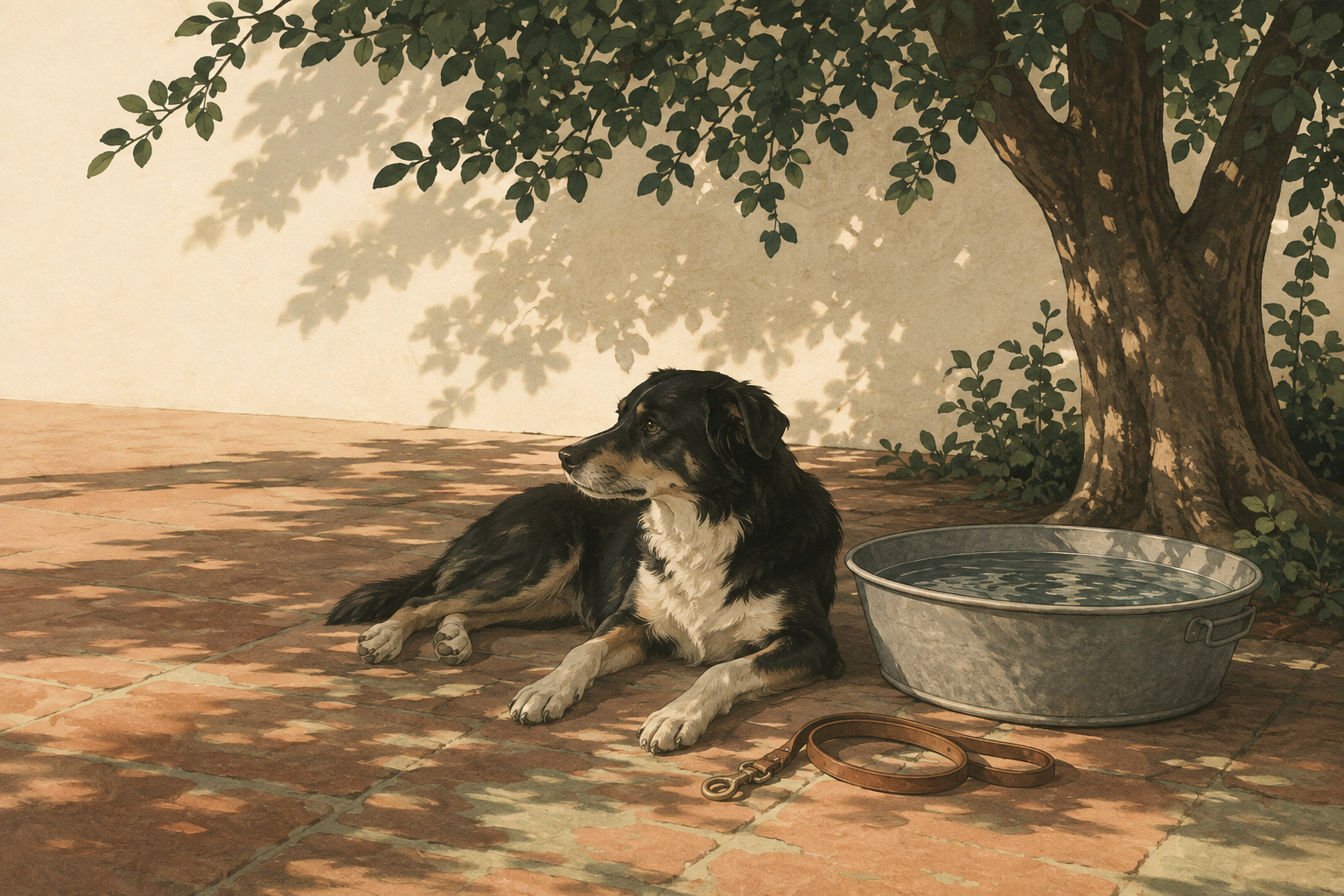
There is a version of this article that runs every July, and you have almost certainly read it. It has a photograph of a labrador behind a car window and a headline about hot cars. It is not wrong, exactly. It is just aimed at the wrong risk.
The largest study of heat-related illness in UK dogs looked at the clinical records of 905,543 animals under primary veterinary care. Confinement in a vehicle accounted for 5.2 per cent of cases. Exercise accounted for 74.2 per cent.
That single number should change how most of us plan a summer's day.
The summer we are actually having
Some context for why this matters more than usual this year.
By 15 July, according to the Met Office, 2026 had already delivered more days above 30°C than the whole of 1976. It became the first year on record to reach 35°C in May, June and July. Spring was the warmest on record for England and Wales. June was England's warmest June in a series going back to 1884.
The detail that matters most for animals, though, is the one that got the least coverage. Overnight temperatures have been tracking at record levels for this stage of the season, with UK minimum temperatures averaging 1.5°C above normal. Met Office Science Manager Amy Doherty noted that the warmth has not been confined to daytime, and that unusually high humidity has made conditions particularly uncomfortable.
A dog that cannot shed heat overnight starts the next day with less margin. So does a rabbit in a hutch, and so does an elderly cat in a first-floor flat.
It does not have to be hot
The most counterintuitive finding in the UK research is about temperature thresholds.
A VetCompass study examining ambient conditions on the days dogs presented with heat-related illness found the median ambient temperature was 16.9°C.
Sixteen point nine. Not a heatwave. A pleasant Tuesday.
This is what makes exertional heat illness different from the hot car scenario. A hot car is a hot environment doing the work. Exertion is the dog doing the work, generating heat faster than it can be shed, and the ambient temperature only has to be warm enough to slow that shedding down. A young, fit, enthusiastic dog on a run in mild weather is a plausible case.
That said, heatwaves concentrate the harm considerably. A 2024 study of 167,751 dogs under emergency care found that 59.6 per cent of the year's heat-related illness cases occurred during just 40 days, the five heatwave periods of 2022.
Both things are true. Cases cluster in heatwaves, and cases happen outside them.
Which animals are carrying the most risk
The same 2024 emergency-care study found that flat-faced dogs had 4.21 times the odds of heat-related illness compared with dogs of typical skull shape. Breed, age and neuter status were all identified as risk factors.
Earlier work found that dogs with impaired thermoregulation, whether from altered anatomy, obesity, or underlying respiratory or circulatory conditions, develop severe illness at relatively low ambient temperatures.
If you own a bulldog, a French bulldog, a pug or a Persian cat, you are not managing the same animal your neighbour is managing. The margin is genuinely narrower, and it narrows further with every extra kilogram.
The Met Office, drawing on British Veterinary Association guidance, notes that dogs account for the largest number of heat-related cases vets see, followed by rabbits and then cats.
What it looks like
Signs are broadly similar in dogs and cats, though the Royal Veterinary College notes they are often more subtle in cats:
- Panting, progressing to distressed or noisy breathing
- Restlessness, pacing, or agitation
- Seeking shade or water, or refusing to continue
- Drooling more than usual
- Wobbliness, weakness, or collapse
- Vomiting or diarrhoea
- Seizures or unconsciousness
Open-mouth breathing in a cat is always significant. Cats sweat very little and regulate largely by seeking cool surfaces and grooming. Most feline cases develop after an animal has been accidentally shut into a shed, greenhouse, conservatory or garage, which is worth remembering if a cat goes missing on a hot afternoon.
In rabbits, watch for rapid breathing, hot or reddened ears, lying stretched out, weakness, or an unusual stillness.
The first aid part, which is where most of us have it wrong
Here is the finding that ought to be better known.
A VetCompass study of dogs presented to UK practices with heat-related illness between 2016 and 2018 found that only 21.7 per cent had been actively cooled before being brought to the clinic. Of those that had been cooled, fewer than a quarter had been cooled by a currently recommended method. More than half had been cooled with wet towels.
Wet towels are better than nothing. But left on the animal they trap heat rather than removing it, and they are considerably slower than the alternatives.
The current best-practice guidance, which the RVC has been actively campaigning on, is cool first, transport second.
The reasoning is straightforward. The damage done by heat illness is a function of how hot the animal gets and how long it stays there. Time spent in a car on the way to the practice, with the temperature still climbing, is time the brain and kidneys are being injured. Cooling on the spot buys back that time.
What the evidence supports:
- For young, healthy dogs: cold water immersion. Research on exercising dogs found immersion in water between 0.1°C and 15°C cooled them rapidly and safely, with no adverse effects observed and many dogs entering the water voluntarily.
- For older dogs, flat-faced dogs, or animals with underlying health problems: evaporative cooling. Pour water over them, any water that is cooler than the animal, and combine it with air movement from a breeze, a fan, or air conditioning.
- In any case: use whatever water you have, provided it is cooler than the animal. Then phone the practice.
The advice to use only tepid or lukewarm water, which circulates every summer, is not supported by evidence. The same idea was tested and discarded in human medicine some time ago.
One caveat worth holding: this is first aid, not treatment. Call the practice once cooling is underway, and have the animal seen even if it seems to have recovered. Serious consequences of heat illness, including kidney damage and clotting problems, are not always apparent in the first hour.
The unglamorous prevention
Most of it is scheduling rather than equipment.
Walk at dawn or dusk and accept that the middle of the day is not available in a hot spell. Test the pavement with the back of your hand before you set off. Take water. Cut the distance and cut the intensity, particularly the games that involve repeated sprinting, because a dog chasing a ball will not self-regulate.
For rabbits and guinea pigs, move hutches into deep shade and check ventilation, remembering that shade moves through the day. Check bottoms twice daily during warm weather: flystrike is a rapid, life-threatening emergency and warm conditions accelerate it.
For cats, check sheds and greenhouses before you close them.
And note the RVC's point that a dog's temperature can continue climbing for several minutes after exercise has stopped. The end of the walk is not the end of the risk window.
Why this is not just a summer article
The Met Office's assessment is that UK heatwaves are likely to become more frequent and more intense, with an estimated 50-50 chance of the UK seeing 40°C again within the next twelve years.
Heat-related illness in dogs has been recorded in every month of the year in UK data. The current summer is not an outlier to be waited out. It is a reasonable preview.
If your animal is in a higher-risk group, the conversation to have with your vet is not an emergency one. It is a fifteen-minute discussion at the next routine appointment about weight, about airway, and about what a realistic exercise plan looks like for the animal you actually have.
Sources
- Hall, E.J., Carter, A.J. and O'Neill, D.G. (2020) 'Dogs Don't Die Just in Hot Cars: Exertional Heat-Related Illness (Heatstroke) Is a Greater Threat to UK Dogs', Animals, 10(8), 1324. https://www.mdpi.com/2076-2615/10/8/1324
- Hall, E.J., Carter, A.J., Chico, G., Bradbury, J., Gentle, L.K., Barfield, D. and O'Neill, D.G. (2022) 'Risk Factors for Severe and Fatal Heat-Related Illness in UK Dogs: A VetCompass Study', Veterinary Sciences, 9(5), 231. https://www.ncbi.nlm.nih.gov/pmc/articles/PMC9144152/
- Beard, S., Hall, E.J., Bradbury, J., Carter, A.J., Gilbert, S. and O'Neill, D.G. (2024) 'Epidemiology of heat-related illness in dogs under UK emergency veterinary care in 2022', Veterinary Record, e4153. https://bvajournals.onlinelibrary.wiley.com/doi/10.1002/vetr.4153
- Hall, E.J. et al. (2023) 'Cooling Methods Used to Manage Heat-Related Illness in Dogs Presented to Primary Care Veterinary Practices during 2016–2018 in the UK'. https://pmc.ncbi.nlm.nih.gov/articles/PMC10385239/
- Royal Veterinary College, 'The RVC urges owners of hot dogs to "cool first, transport second"'. https://www.rvc.ac.uk/vetcompass/news/the-rvc-urges-owners-of-hot-dogs-to-cool-first-transport-second
- Royal Veterinary College, 'Heatstroke in dogs and cats: prevention, symptoms and first aid tips for pet owners'. https://www.rvc.ac.uk/small-animal-vet/teaching-and-research/fact-files/heatstroke-in-dogs-and-cats
- Met Office (16 July 2026), 'Summer 2026 so far: A look at the season at the halfway point'. https://www.metoffice.gov.uk/blog/2026/summer-2026-so-far-a-look-at-the-season-at-the-halfway-point-
- Met Office, 'Looking after your pets during hot weather'. https://weather.metoffice.gov.uk/warnings-and-advice/seasonal-advice/health-wellbeing/looking-after-pets-during-hot-weather
- PDSA, 'Heatstroke in cats'. https://www.pdsa.org.uk/pet-help-and-advice/pet-health-hub/conditions/heatstroke-in-cats
This article is general information and is not a substitute for veterinary advice. If you are worried about your animal, contact your veterinary practice.